Browser evaluations · technical guide
What Is Chrome Fingerprinting?
How Chrome remains recognizable when context changes.A layer-by-layer examination of what a site can observe, what Incognito and a VPN actually change, and what one commercial recognition system returned during controlled boundary tests.
This page explains the recorded behavior and relevant browser surfaces. It does not reverse-engineer Fingerprint's proprietary model, identify a hardware serial, or claim that every tracker can reproduce the result.
01 · Finding
Chrome was recognized as a returning visitor after multiple context changes.
In the recorded runs, changing local session mode, restarting Chrome, moving to a different server-observed public IP, and creating a fresh Chrome profile did not reliably produce a new visitor alias.
Changed
- Normal ↔ Incognito
- Browser process
- Chrome profile
- Observed network path
Returned
Same returned visitor alias
02 · Evidence
View the 14 captures
The image below demonstrates that incognito mode was on and the IP address changed while the visitor identifier remained the same. The JSON below outlines fourteen captures and preserves repeated-value relationships across two devices.
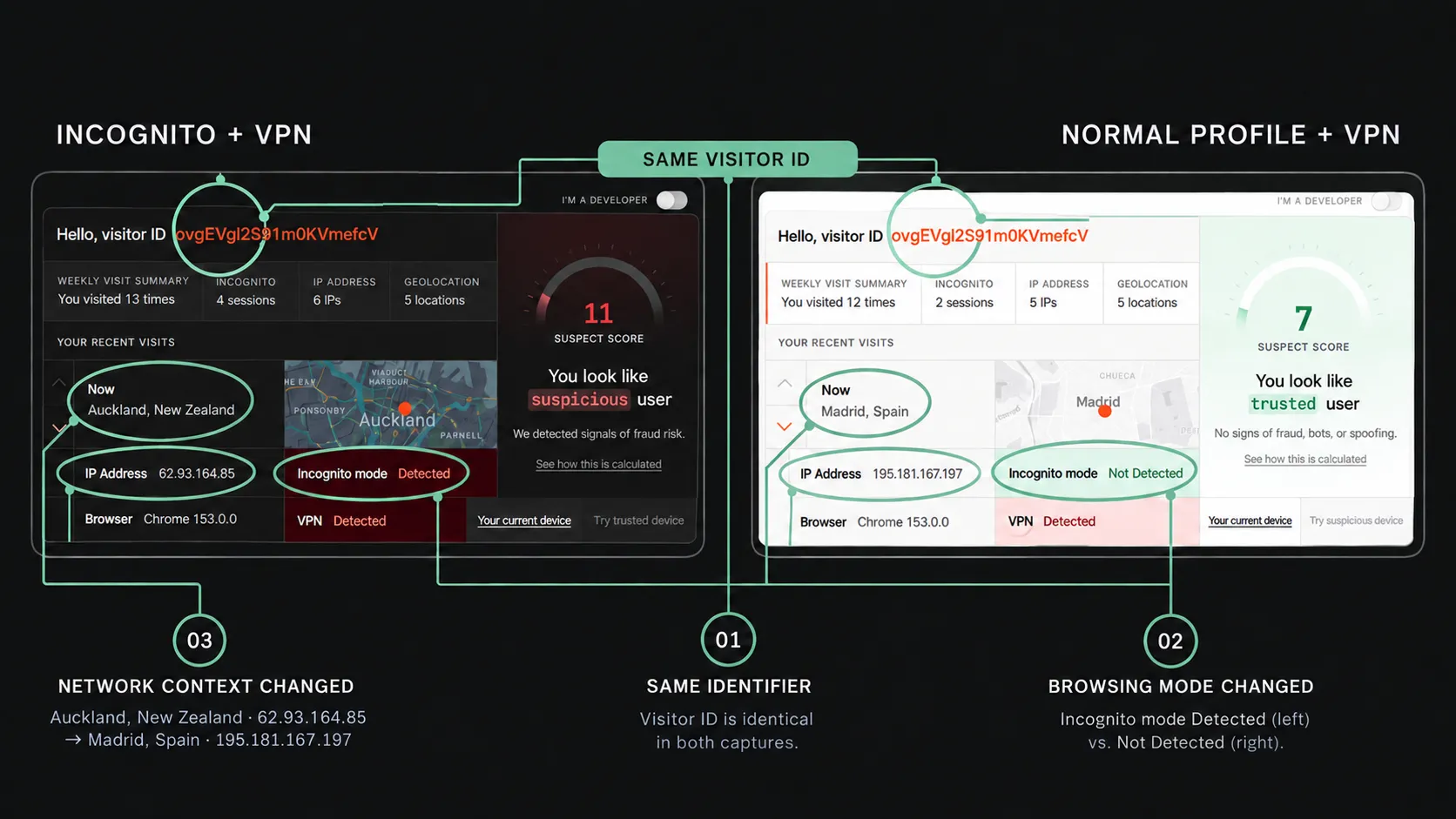
Public evidence set
Inspect all 14 captures.
Choose a capture to compare the intervention, returned alias, and complete synthetic response.
Device A
Baseline · home network
- Intervention
- baseline
- Changed from prior capture
- initial observation
- Held constant
- None recorded
- Returned
- ABC · 1.00 confidence
{
  "capture_id": "CAPTURE-001",
  "baseline": false,
  "scenario": "Baseline · home network",
  "browser": "Chrome",
  "device_alias": "Device A",
  "environment_alias": "Environment A",
  "captured_at": "1788912905255",
  "interventions": [
    "baseline"
  ],
  "changed_from_previous_capture": [
    "initial observation"
  ],
  "held_constant_from_previous_capture": [],
  "result": {
    "visitor_alias": "ABC",
    "confidence": 1,
    "ip_address": "192.0.2.10",
    "city": "Zurich",
    "timezone": "Europe/Zurich",
    "incognito": false,
    "vpn": false
  },
  "server_response": {
    "event_id": "EVENT-001",
    "timestamp": "2026-08-01T14:00:00Z",
    "source": "device",
    "environment_id": "ENVIRONMENT-EB5D9A",
    "sdk": {
      "platform": "js",
      "version": "4.1.5",
      "integrations": [
        {
          "name": "custom-proxy-integration",
          "version": "1.0.2"
        },
        {
          "name": "custom-proxy-integration",
          "version": "1.0.4"
        },
        {
          "name": "fingerprintjs-pro-react",
          "version": "3.0.0"
        }
      ]
    },
    "replayed": false,
    "identification": {
      "visitor_id": "ABC",
      "confidence": {
        "score": 1,
        "version": "v1.1"
      },
      "visitor_found": false,
      "first_seen_at": "2026-08-01T14:00:00Z",
      "last_seen_at": null
    },
    "tags": {
      "referrerLink": "public-evaluation"
    },
    "url": "https://example.test/demo",
    "ip_address": "192.0.2.10",
    "user_agent": "Mozilla/5.0 (Windows NT 10.0; Win64; x64) AppleWebKit/537.36 (KHTML, like Gecko) Chrome/153.0.0.0 Safari/537.36",
    "device": "Other",
    "os": "Windows",
    "os_version": "11",
    "browser_details": {
      "browser_name": "Chrome",
      "browser_major_version": "153",
      "browser_full_version": "153.0.0",
      "os": "Windows",
      "os_version": "11",
      "device": "Other"
    },
    "bot": "not_detected",
    "developer_tools": false,
    "ip_blocklist": {
      "email_spam": false,
      "attack_source": false,
      "tor_node": false
    },
    "ip_info": {
      "v4": {
        "address": "192.0.2.10",
        "geolocation": {
          "accuracy_radius": 20,
          "latitude": 47.3769,
          "longitude": 8.5417,
          "postal_code": "8001",
          "timezone": "Europe/Zurich",
          "city_name": "Zurich",
          "country_code": "CH",
          "country_name": "Switzerland",
          "continent_code": "EU",
          "continent_name": "Europe",
          "subdivisions": [
            {
              "iso_code": "CH-01",
              "name": "Zurich Region"
            }
          ]
        },
        "asn": "AS64500",
        "asn_name": "Example Network 1",
        "asn_network": "192.0.2.0/24",
        "asn_type": "isp",
        "datacenter_result": false
      }
    },
    "proxy": false,
    "proxy_confidence": "high",
    "proxy_ml_score": 0.182,
    "incognito": false,
    "privacy_settings": false,
    "suspect_score": 0,
    "tampering": false,
    "tampering_confidence": "high",
    "tampering_ml_score": 0.0044,
    "tampering_details": {
      "anomaly_score": 0,
      "anti_detect_browser": false
    },
    "velocity": {
      "distinct_ip": {
        "5_minutes": 1,
        "1_hour": 1,
        "24_hours": 1
      },
      "distinct_country": {
        "5_minutes": 1,
        "1_hour": 1,
        "24_hours": 1
      },
      "events": {
        "5_minutes": 1,
        "1_hour": 1,
        "24_hours": 1
      },
      "ip_events": {
        "5_minutes": 1,
        "1_hour": 1,
        "24_hours": 1
      }
    },
    "virtual_machine": false,
    "virtual_machine_ml_score": 0.08,
    "vpn": false,
    "vpn_confidence": "high",
    "vpn_ml_score": 0.049,
    "vpn_origin_timezone": "Europe/Zurich",
    "vpn_origin_country": "COUNTRY-EB8BF0",
    "vpn_methods": {
      "timezone_mismatch": false,
      "public_vpn": false,
      "auxiliary_mobile": false,
      "os_mismatch": false,
      "relay": false,
      "ml_prediction": false
    },
    "high_activity_device": false,
    "rare_device": false,
    "rare_device_percentile_bucket": "p95-p99",
    "raw_device_attributes": {
      "font_preferences": {
        "default": 143.124375,
        "serif": 143.124375,
        "sans": 138.304219,
        "mono": 117.829219,
        "apple": 143.124375,
        "min": 15.752813,
        "system": 141.802031
      },
      "emoji": {
        "font": "Synthetic Serif",
        "width": 1606.575,
        "height": 22.72,
        "top": 17.26,
        "bottom": 32.73,
        "left": 14.53,
        "right": 1613.855,
        "x": 14.53,
        "y": 17.26
      },
      "fonts": [
        "FONT-591537",
        "FONT-609811",
        "FONT-60421E",
        "FONT-0DFBBB",
        "FONT-CFA057",
        "FONT-228B88",
        "FONT-3543CA",
        "FONT-D8E29B",
        "FONT-6D19B7",
        "FONT-AD138B",
        "FONT-80CFB7",
        "FONT-76971E",
        "FONT-0290E5"
      ],
      "device_memory": 16,
      "timezone": "Europe/Zurich",
      "canvas": {
        "winding": true,
        "geometry": "GEOMETRY-F503B1",
        "text": "TEXT-093939"
      },
      "languages": [
        [
          "de-CH"
        ]
      ],
      "webgl_extensions": {
        "context_attributes": "6b1ed336830d2bc96442a9d76373252a",
        "parameters": "PARAMETERS-74AECA",
        "shader_precisions": "SHADER_PRECISIONS-3EBCB8",
        "extensions": "2ec6a06c62e232a16e719d1738edbc16",
        "extension_parameters": "EXTENSION_PARAMETERS-CAD557",
        "unsupported_extensions": []
      },
      "webgl_basics": {
        "version": "WebGL 1.0 (OpenGL ES 2.0 Chromium)",
        "vendor": "WebKit",
        "vendor_unmasked": "VENDOR_UNMASKED-7753EF",
        "renderer": "RENDERER-21028B",
        "renderer_unmasked": "RENDERER_UNMASKED-81EA1F",
        "shading_language_version": "WebGL GLSL ES 1.0 (OpenGL ES GLSL ES 1.0 Chromium)"
      },
      "screen_resolution": [
        1600,
        900
      ],
      "touch_support": {
        "touch_event": false,
        "touch_start": false,
        "max_touch_points": 0
      },
      "architecture": "ARCHITECTURE-9556B8",
      "cookies_enabled": true,
      "hardware_concurrency": 8,
      "date_time_locale": "de-CH",
      "vendor": "Google Inc.",
      "color_depth": 24,
      "platform": "Win32",
      "session_storage": true,
      "local_storage": true,
      "audio": "AUDIO-C40EDA",
      "plugins": [
        "PLUGIN-C80FD4",
        "PLUGIN-55F403",
        "PLUGIN-8DC338",
        "PLUGIN-8AE52F",
        "PLUGIN-99FFE1"
      ],
      "indexed_db": true,
      "math": "MATH-EA13A6",
      "font_hash": "FONT_HASH-18F30E",
      "timezone_offset": "+01:00",
      "battery_level": 87,
      "battery_charging": true,
      "keyboard_layout_hash": "KEYBOARD_LAYOUT_HASH-4F748B",
      "keyboard_layout_name": "de-CH"
    },
    "client_referrer": "https://example.test/"
  },
  "js_agent_response": {
    "event_id": "EVENT-001",
    "visitor_id": "ABC",
    "suspect_score": 0,
    "cache_hit": true,
    "sealed_result": "REMOVED_FROM_PUBLIC_COPY"
  }
}
This is a synthetic public copy, not a fictional result: repeated source values receive the same substitute across all fourteen captures. Boolean findings, counts, versions, confidence values, and change relationships are retained. Sealed vendor payloads and original identifying values are not deployed.
03 · Surfaces
Recognition occurs across multiple layers.
Chrome reduces some passive details, including the legacy User-Agent string, while retaining a capable web platform. A recognizer can combine browser-exposed values with request, network, historical, and account context.
Request metadata
PassiveEvery request carries protocol and header context before page JavaScript executes.
- User-Agent reduction
- Client Hint headers
- Accept-Language
- HTTP protocol behavior
Chrome reduces some passive detail, but a server still receives a structured request and may request additional Client Hints.
Chrome for DevelopersChrome for DevelopersThe Chromium Projects
Runtime environment
ActivePage scripts can query browser, display, language, timing, and device-adjacent properties.
- Screen and pixel ratio
- Languages and timezone
- Hardware concurrency
- Media and permission behavior
Individual fields can be common. A recognizer evaluates the combination, its stability, and how it changes over time.
Rendering behavior
ActiveCanvas, WebGL, text metrics, and related APIs can expose differences in the graphics and font pipeline.
- Canvas output
- WebGL renderer behavior
- Font metrics
- Color and image processing
Rendering output is not a serial number. It is one partial fingerprint whose value depends on the surrounding signals and observer.
Connection context
Server-sideThe destination observes the public route and server-side request behavior independently of local browser storage.
- Public IP address
- Proxy or VPN classification
- Geolocation inference
- Request history
A VPN changes the visible network path. It does not necessarily change the browser or device observations that arrive through that path.
Signed-in continuity
Account contextChrome profile state and direct use of Google services can add durable account context when the user signs in or enables relevant settings.
- Chrome profile
- Sync categories
- Google Account
- Direct service activity
This is a separate pathway from fingerprinting. It matters because multiple correlation pathways can coexist.
const surface = {
  languages: navigator.languages,
  timezone: Intl.DateTimeFormat().resolvedOptions().timeZone,
  screen: `${screen.width}×${screen.height}@${devicePixelRatio}`,
  cores: navigator.hardwareConcurrency,
  memory: navigator.deviceMemory ?? null,
};

console.table(surface);
Illustrative collection code. These values are not independently unique and this is not the vendor's implementation.
const lowEntropy = navigator.userAgentData?.brands;
const requested = await navigator.userAgentData?.getHighEntropyValues([
  'architecture',
  'bitness',
  'model',
  'platformVersion',
  'fullVersionList',
]);
High-entropy hints are requested explicitly and availability may vary by browser, policy, context, and version.
const canvas = document.createElement('canvas');
const ctx = canvas.getContext('2d');
ctx.font = '16px sans-serif';
ctx.fillText('404 privacy', 8, 24);

const pixels = canvas.toDataURL();
const width = ctx.measureText('404 privacy').width;
A teaching example only. Production recognizers can use multiple rendering operations and server-side context.
04 · Boundary behavior
Test conditions
| Boundary | What changed | Observed return | Narrow interpretation |
|---|---|---|---|
| Normal → Incognito | Compare a normal window with an Incognito window on the same device. Device B changes both session mode and server-observed IP, then returns to the earlier IP. | Same visitor identifier | Local session isolation did not prevent recognition by this demo. |
| Browser restart | Close all Chrome windows and processes, relaunch Chrome, and revisit the demo. Device B isolates the restart on the same IP; Device A combines restart with a VPN change. | Same visitor identifier | Ending the browser process did not create a new identity in the recorded device run. |
| Network change | Compare responses after the server observes a different public IP. Device A moves from the home network to a VPN endpoint; Device B moves between two observed IPs. | Same visitor identifier | A changed server-observed IP did not prevent recognition in either standard device run. |
| New Chrome profile | Create a separate Chrome profile without importing the original profile's local browsing data. The new-profile request stays on the same observed VPN endpoint on Device A and the same observed IP on Device B. | Same visitor identifier | A fresh local profile did not prevent recognition in the recorded configurations. |
| Highly modified context | Restart across VPN endpoints A, B, C, and D; compare normal and Incognito requests and the returned aliases. | Persistent alternate identifier | Both aliases persisted. ABC crossed from the home network to endpoint C and from normal to Incognito there; HIJ crossed endpoints A, B, and D. |
05 · Surveillance Architecture
Recognition happens because multiple layers agree.
Browser Surface
Browser and rendering surface
JavaScript APIs · screen · language · graphics · timingChanged only when the browser environment changes (chromium v. firefox)Local session
Cookies, storage, and profile state
Normal profile · Incognito partition · fresh profileChanged when using incognito mode or separate/guest profilesRequest
Headers, protocol, and public network context
Client Hints · HTTP behavior · public IP · proxy classificationA VPN primarily changes the outward network pathServer history
Prior observations and correlation
Returned IDs · timestamps · event history · confidenceThe vendor's proprietary model operates hereAccount context
Signed-in browser and service activity
Chrome profile · sync · Google Account · direct service useA separate continuity path. Not the same as fingerprintingVPNs change your network path, not browser environment; and Chrome's Incognito documentation explicitly warns that websites and network operators may still observe activity. When these tools are combined, they can lead to meaningful identity separation (Identity C). Though, consistent application and careful management are required to achieve this effect.
06 · Direction
Chrome secures and narrows selected surfaces without standardizing all users.
Shipped
User-Agent reduction
The default User-Agent string exposes less passive detail, while sites can request structured Client Hints.
Chrome 152
Privacy Sandbox removals
Private Aggregation and related APIs were removed after Google's broader Privacy Sandbox direction changed.
Current distinction
Security v. Privacy
Exploit mitigation, permissions, and storage partitioning address important risks without making Chrome users indistinguishable.
Version tracking belongs here because implementation changes. The evaluation verdict remains a broad current overview; release-specific observations should link back to dated evidence and Chrome's primary release notes.
07 · Sources
Primary documentation and test provenance.
- Identification request and visitor ID responseFingerprint · accessed
- Browse in Incognito modeGoogle Chrome Help · accessed
- What is User-Agent reduction?Chrome for Developers · accessed
- User-Agent Client HintsChrome for Developers · accessed
- Chromium network stackThe Chromium Projects · accessed
- Privacy Budget glossary: identifiable surfacesChromium source documentation · accessed
- Chrome Security FAQ: active and passive fingerprintingChromium source documentation · accessed
- Chrome 152 release notesChrome for Developers · accessed
- Update on plans for Privacy Sandbox technologiesGoogle Privacy Sandbox · accessed
- Sign in to ChromeGoogle Chrome Help · accessed
- Manage Web & App ActivityGoogle Account Help · accessed
Need the plain-language judgment and use-case guidance?
Is Google Chrome Private? Read the review →