
Most days, the harms of the advertising ecosystem don't extend into true, real world consequences. Even when they do, they're obscured behind legal jargon and not a central piece of the puzzle.
Today, that was not the case.
Citizen Lab, a digital accountability research laboratory at the University of Toronto, released an investigation into a new spyware delivery system they're calling AdFection.
The investigation documents the first publicly confirmed use of targeted advertising to deliver zero-click mercenary spyware.
This technique was used to target at least 45 Windows devices belonging to journalists at Al Jazeera during 2024 and 2025. Devices were reached through advertisements placed by an Israeli company called Discover-Tech. Selected devices were then directed into infrastructure associated with Candiru, a mercenary spyware developer now operating as Integrity Labs
I have often critiqued the online advertising business, called it predatory mass surveillance, but Citizen Labs outlines here why the issues with the internet can no longer be addressed with anti-phishing campaigns and vague policies.
It's also worth noting, the affected users didn't click the advertisement or download any attachments. The spyware was delivered by simply rendering an ad in the user's browser.
This is obviously a spyware story, but it is also an advertising story because Discover-Tech did not build i for locating people and delivering code to their devices. It used the existing automated advertising ecosystem that has already decided which advertisement you see when you open a website or mobile app.
AdFection did not introduce a new surveillance pipeline. It weaponized the one that is already operating across the web.
What happens when an advertisement loads
When you open an ad-supported website or app, the empty advertising space is offered through a real-time auction. Information about you and your device is sent to advertising companies so they can decide whether they want to bid for the ad-space on your screen.
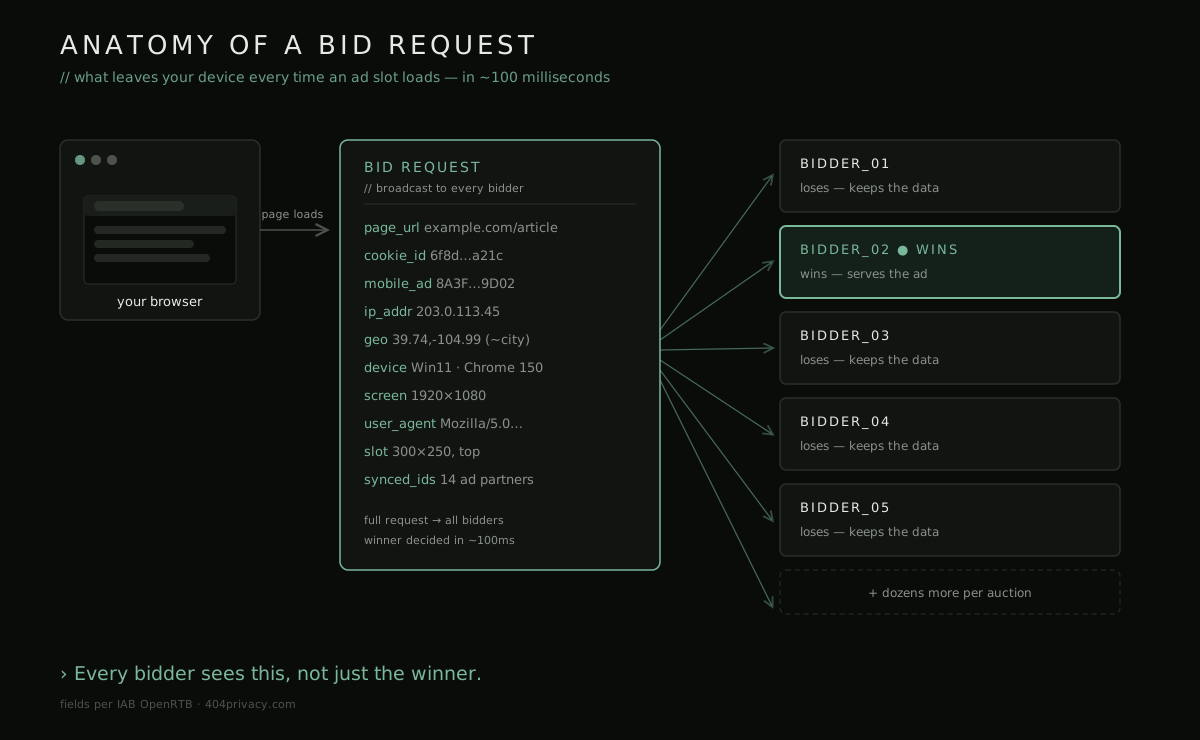
Depending on the platform, device, consent state, publisher settings, and applicable privacy rules, a bid request may contain or expose information such as:
- The website or app requesting the advertisement
- A cookie identifier or mobile advertising ID (Google User ID)
- An IP address or an IP-derived location
- Publisher-provided identifiers
- Identifiers previously synchronized between advertising companies
- Browser, operating system, and device information
- The dimensions and location of the advertising space
This process is supposed to answer an advertising question: how much is this person's attention worth to me.
An auction allows bidders to see this information so that they can decide if they want to bid and how much. A bidder needs enough information to recognize an audience, evaluate how much an individual is worth to them, and determine whether the person and device match their targeting criteria.
That means a company does not always need to win the auction to learn about a user–who you are, what you like to do, what website you were visiting, where you were, and what device you were on.
Google even provides documentation explaining how Authorized Buyers can use bid requests to build user profiles and outlining how advertisers can track users using an identifier, such as a Google User ID, and information that can later be used for interest-based advertising or remarketing.
The stated purpose is advertising. The underlying capability is persistent recognition and mass surveillance.
How AdFection used that system
According to Citizen Lab’s report, Discover-Tech operated its own demand-side platform called MyDSP and participated in advertising markets operated by companies including Google and Yandex. It also purchased ads through other platforms, including Beeswax and Eskimi.
Jerome Dangu said Discover-Tech was serving more than 10 million ads a day.
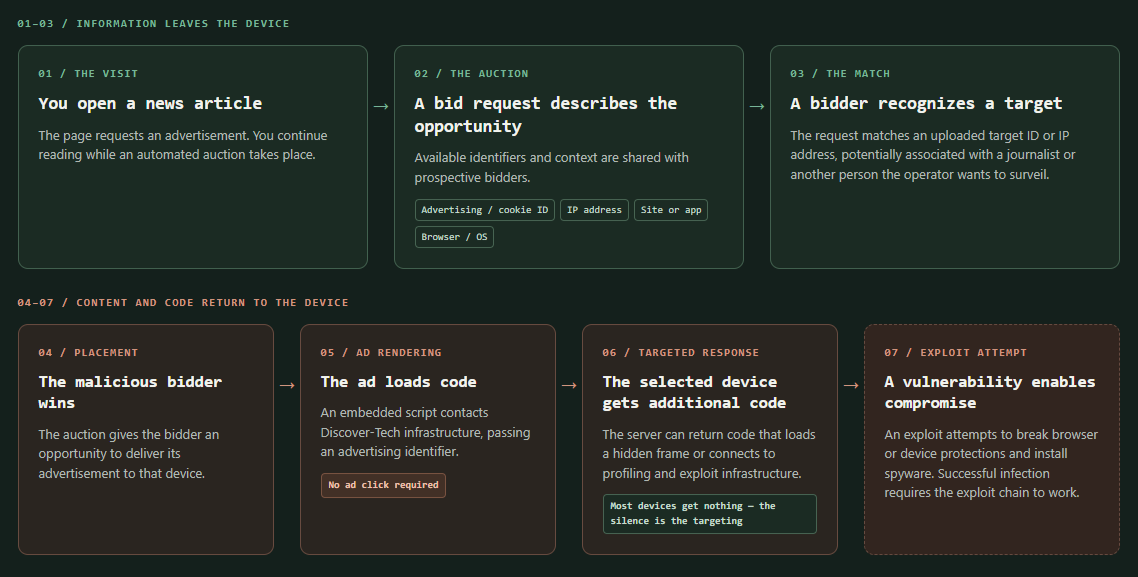
Discover-Tech was not merely buying broad access to an audience. Its Controlium platform allowed operators to upload specific identifiers, including Android and Apple mobile advertising IDs, Beeswax user IDs, MyDSP user IDs, and IP addresses.
Those identifiers could then be placed into advertising “segments,” the same general mechanism used to create audiences for ordinary targeted advertising.
Controlium also allowed an operator to inspect recent bid requests associated with a particular identifier or IP address. The available records could include the user ID, IP address, website visited or app used, and other attributes.
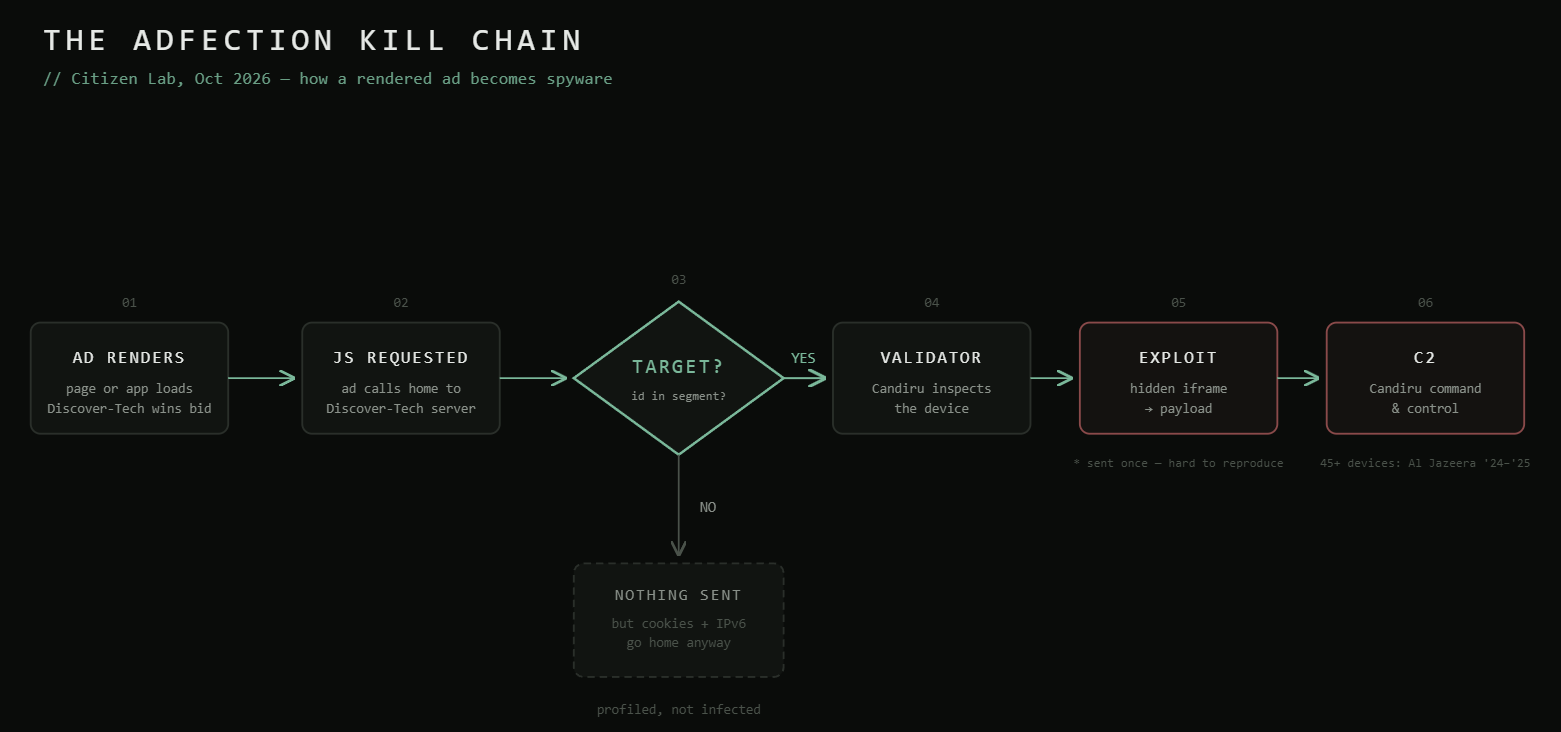
Once Discover-Tech won an auction, its advertisement could cause the browser or app to request JavaScript from a Discover-Tech server.
For most people who received one of these ads, the server might return nothing. The malicious response was only sent when a device matched one belonging to the operator’s targets.
Controlium allowed operators to upload specific mobile advertising IDs, browser identifiers, IP addresses, and other identifiers that may already have been associated with a journalist, government employee, organization, or other person of interest. The wider advertising system could also help narrow opportunities by location, website or app, device characteristics, and audience segment. When one of those targeted devices appeared in an auction and Discover-Tech won the impression, its server could return code that created a hidden iframe, redirected the device into additional profiling infrastructure, or initiated delivery of a browser exploit.
Citizen Lab found evidence suggesting that this code was designed to be sent only once. Subsequent requests could return nothing, making the behavior much harder for advertising platforms and security scanners to reproduce.
Information flowed from the person’s device into the auction, allowing bidders to recognize and evaluate the opportunity. Code then flowed from the winning bidder back into the person’s browser or app.
What happened at Al Jazeera
Citizen Lab examined network logs collected by Al Jazeera during attacks in 2024 and 2025. At least 45 devices were targeted.
The logs showed a consistent sequence.
- A device contacted Discover-Tech infrastructure, indicating that an advertisement had rendered.
- It then contacted a Candiru validator server, which inspected the device before further profiling and infection.
- Compromised devices communicated with Candiru command-and-control infrastructure.
Al Jazeera also isolated a Windows DLL from one compromised device.
In some cases, the ad may not even have been visibly displayed, rendering the ad was enough to initiate the attack.
How did Discover-Tech identify targets?
The report establishes that Discover-Tech participated in Google’s advertising ecosystem, served ads through Google, and had been included on several Google vendor lists since 2020.
Google listed Discover-Tech as a demand-side platform that could access the Google Display Network and as an advertising-personalization provider.
The report doesn't establish how the operators first obtained the identifiers they used to target Al Jazeera's staff. It could have come from previous advertising activity, a synchronized ad ID, another surveillance vendor, a data broker, a compromised account, a known IP address, physical access, public information, or some other intelligence source. It's anyone's guess.
But honestly, it was probably pretty easy. You don't need a name. Consider how little it takes:
IP addresses identify the employer. Bid requests carry IP addresses. Al Jazeera's office networks are observable, and any device bidding from those ranges during work hours is probably an Al Jazeera device. Literally 0 effort.
Behavior patterns identify the role. The entire advertising industry is built to answer "show me people interested in X." This system will happily label someone who regularly visits press-freedom resources, journalism tools, and Middle East news analysis as a journalism-interested audience. "Likely journalist" is just a targeting checkbox, not an intelligence breakthrough.
Intersection and historical behavior identify the person. This is the clever one. Suppose Al Jazeera published on ten specific topics over six months. Each topic has a broad audience, thousands of ad IDs visited websites related to a singular topic. But the number of IDs that show up on sites relevant to all ten topics is much smaller. Ten broad circles overlapping leaves a very small lens in the middle, and the people in that lens are disproportionately likely to be the journalists who wrote those stories. This is set-intersection de-anonymization, and the ad ecosystem performs it continuously as a feature.
An operator doesn't need anyone to hand over a neat file with a name, employer, and browsing history. The advertising system is designed to find "people like these."
Discover-Tech’s exposed database contained almost four billion bid records from March through June 2026. Approximately 24.7 percent were labeled as originating through Google Ad Manager, while most were labeled as originating through Yandex. The database contained IP addresses or partial IP ranges and city-level location information.
Those particular exposed records do not tell us how the operators first obtained the identifiers used to target Al Jazeera. Once the operator had an identifier, however, the advertising system offered a way to wait for attackers to target that device.
Blast Radius
Citizen Lab found evidence that Discover-Tech delivered an advertisement on NBCNews.com in August 2025 using its MyDSP system and Google. The advertisement generated requests to Discover-Tech-associated tracking infrastructure.
That finding demonstrates how deeply Discover-Tech had entered ordinary advertising supply chains.
Citizen Lab observed Discover-Tech ads across a huge range of websites and apps, including major news sites, weather services, email apps, messaging apps, dating apps, period trackers, games, and language-learning services.
Between March and June 2026 alone, Discover-Tech bid on approximately 3.77 billion impressions and apparently won around 442 million. Citizen Lab found ads containing apparent attacker-controlled script tags across more than 75,000 mobile apps and 120,000 websites.
Advertising data becomes attack intelligence
There is a tendency to separate commercial surveillance from state surveillance.
Advertising companies collect identifiers, locations, device information, browsing context, and behavioral data to sell ads. Spyware companies develop exploits to enter devices. Governments purchase surveillance tools to target people.
AdFection demonstrates a deep connection between those systems.
An advertising identifier may be "pseudonymous" because it is not attached to your name, but that does not prevent it from being used to follow you around the internet forever, learning more about you every time you use online services. An IP address may be described as approximate or temporary. That does not prevent it from revealing that a device has appeared inside a newsroom, government agency, military network, or other sensitive organization. A bid request may be described as an opportunity to value an advertisement. That does not prevent the recipient from using it as a surveillance event.
The danger is not limited to the treasure trove of data that advertising companies already possess. The danger is the ecosystem itself. A global, automated system continuously advertising people's attention and then allowing winning bidders to place code in front of them.
The industry failure
Discover-Tech appears on Google and IAB Europe vendor lists going back to 2020. Google described it as an approved demand-side platform capable of accessing the Google Display Network. IAB Europe also allowed it to participate in its consent framework.
Citizen Lab reports that publicly accessible corporate records had already connected people associated with Discover-Tech to the mercenary spyware industry.
Meanwhile, Discover-Tech’s ads were allowed to appear across hundreds of thousands of sites and apps.
Following Citizen Lab’s disclosure, Google terminated Discover-Tech’s access to its exchanges and removed it from vendor registries. IAB Europe, Beeswax, Vungle, and Eskimi also took action.
Those responses are appropriate, but they come after Discover-Tech had spent years embedded within the advertising ecosystem.
The larger failure was allowing a company linked to mercenary surveillance to receive bid data, synchronize identifiers, purchase targeted access to devices, and return executable content at enormous scale.
What actually helps
Nothing on this list fixes the underlying system, but several things would have broken this specific attack.
Block the ad, break the chain. This whole attack required the malicious ad to render. A competent ad blocker (uBlock Origin, not the "acceptable ads" kind) prevents the ad from loading at all, which means the JavaScript request to Discover-Tech's server never happens. It's the least sophisticated defense here, but the most effective one against this exact technique.
Tor or Mullvad Browser makes you hard to profile. Everyone on these browsers look identical. If you're using the Tor Network or a VPN, there's no real IP or location to feed the auction. Discover-Tech's profiling depends on distinguishing you from the crowd. Further, this specific payload needed JavaScript from the attacker's server, Tor's Safest mode disables JavaScript entirely, preventing this attack. Default Tor Browser allows JavaScript, and Candiru's exploit targeted Windows. Tor on Windows is still Windows, much harder to target, but still possible to exploit.
Fingerprint protection starves the identification layer. Without a stable fingerprint, it's harder to say "this is the same journalist we saw yesterday" or to identify targets out of the noise. If the malicious ad gets served anyway, the zero-click doesn't care what your fingerprint looks like.
Notice what none of these do: they don't fix the auction. They defend the individual against a parasitic system that feeds on their data. The Al Jazeera journalists would have been meaningfully safer with any of these protections in place, but it's defense against a business model, not a bug.
The lesson from AdFection
The most important conclusion is not that people should be more careful about which advertisements they click.
Those targeted at Al Jazeera did not click anything.
The lesson is that real-time advertising creates a continuous connection between dozens of providers and all of our online behavior. It tells bidders that a device is available and supplies information to recognize or evaluate it and its owner.
For most advertisers, that connection is used to sell shoes and deliver targeted political messages. Discover-Tech and its partners demonstrated that the same system can be used to profile millions of people, wait for selected identifiers and profiles, and deliver spyware to targeted individuals.
This needs to change how we discuss both spyware and advertising.
Targeted advertising is not only a privacy concern because companies can learn and predict what people read, where they travel, or what they may purchase. It's a concern because that information can be handed out to anyone willing to bid on the space.
